
Why Are You Unable to Get Pregnant? 25 Hidden Causes of Infertility Every Couple Must Know Before It’s Too Late

Why Are You Unable to Get Pregnant? 25 Hidden Causes of Infertility Every Couple Must Know Before It’s Too Late
Article Outline
- Why Are You Unable to Get Pregnant? 25 Hidden Causes of Infertility Every Couple Must Know Before It’s Too Late
- Understanding Infertility in Modern Couples
- How Common Is Infertility Today?
- When Should Couples Seek Medical Help?
- Hidden Female Fertility Problems
- PCOS and Hormonal Imbalances
- Endometriosis and Silent Inflammation
- Blocked Fallopian Tubes
- Premature Ovarian Insufficiency
- Uterine Fibroids and Polyps
- Thyroid Disorders
- Autoimmune Conditions
- Hidden Male Fertility Problems
- Low Sperm Count
- Poor Sperm Motility
- Varicocele
- Hormonal Disorders in Men
- Genetic Factors
- Lifestyle Factors Destroying Fertility
- Obesity and Poor Diet
- Chronic Stress
- Smoking and Alcohol
- Lack of Sleep
- Environmental Toxins
- The 25 Hidden Causes of Infertility Explained
- Complete List and Risk Factors
- Which Causes Are Reversible?
- Diagnosis and Fertility Testing
- Essential Tests for Women and Men
- Treatment Options and Hope for Couples
- Conclusion
- FAQs
- Understanding Infertility in Modern Couples
Understanding Infertility in Modern Couples
For many couples, the journey toward parenthood begins with excitement and hope. Yet month after month, some couples find themselves staring at a negative pregnancy test, wondering what went wrong. The reality is that infertility is far more common than most people realize. According to the World Health Organization (WHO), approximately 1 in 6 people worldwide experience infertility during their reproductive years. This staggering statistic highlights that fertility challenges are not rare exceptions—they are a widespread health concern affecting millions of families globally.
Infertility is medically defined as the inability to achieve pregnancy after 12 months of regular, unprotected intercourse. For women over 35, doctors often recommend seeking evaluation after six months of trying. What makes infertility particularly frustrating is that many couples appear perfectly healthy on the surface. They exercise, eat reasonably well, and have no obvious symptoms. Yet beneath the surface, hidden factors may be silently interfering with conception. These hidden causes can involve hormonal imbalances, reproductive abnormalities, lifestyle choices, environmental exposures, or even unexplained biological factors.
The good news is that many infertility causes are treatable once properly identified. Unfortunately, countless couples delay testing because they assume pregnancy will happen naturally with time. Understanding the hidden reasons behind infertility can help couples take action sooner, potentially improving their chances of building the family they dream of.
How Common Is Infertility Today?
Modern lifestyles have changed dramatically over the past few decades. People are choosing to marry later, pursue careers longer, and postpone parenthood. While these choices offer many advantages, they also influence reproductive health. Female fertility naturally declines with age, especially after 35, while male fertility can also decrease as men get older. Experts have observed increasing concerns related to obesity, stress, environmental toxins, and sedentary lifestyles, all of which can negatively affect fertility.
Many people mistakenly assume infertility is primarily a female issue. Research consistently shows that male factors contribute to nearly half of infertility cases. The challenge is that male infertility often receives less attention and fewer diagnostic evaluations. Fertility should always be viewed as a shared responsibility between both partners. A comprehensive fertility assessment examines the health of both individuals rather than focusing solely on one person.
Hidden Female Fertility Problems
Women’s reproductive systems involve a delicate balance of hormones, organs, and biological processes. Even minor disruptions can interfere with conception.
PCOS and Hormonal Imbalances
Polycystic Ovary Syndrome (PCOS) is considered one of the most common causes of female infertility. PCOS affects ovulation by disrupting hormone levels, making it difficult for the ovaries to release mature eggs regularly. Women with PCOS may experience irregular periods, weight gain, acne, or excessive hair growth, although some women show very few symptoms.
Hormonal imbalances extend beyond PCOS. Elevated prolactin levels, insulin resistance, and disruptions in follicle-stimulating hormone (FSH) and luteinizing hormone (LH) can all affect fertility. Because hormone levels influence every stage of reproduction, identifying and correcting these imbalances often leads to successful pregnancies.
Endometriosis and Silent Inflammation
Endometriosis occurs when tissue similar to the uterine lining grows outside the uterus. This condition can cause inflammation, scarring, and damage to reproductive organs. Some women experience severe pelvic pain, while others have no symptoms at all. This makes endometriosis one of the most overlooked fertility problems.
Silent inflammation may affect egg quality, fertilization, implantation, and embryo development. Many women discover they have endometriosis only after undergoing fertility evaluations or surgical procedures.
Blocked Fallopian Tubes
The fallopian tubes act as the meeting place for sperm and egg. If these tubes become blocked due to infections, pelvic inflammatory disease, previous surgeries, or scar tissue, fertilization becomes impossible. Unfortunately, blocked tubes rarely cause noticeable symptoms.
A woman may continue having regular menstrual cycles while unknowingly carrying a tubal blockage. Specialized imaging tests are often required to detect these issues.
Premature Ovarian Insufficiency
Some women experience declining ovarian function before age 40. This condition, known as Premature Ovarian Insufficiency (POI), reduces both egg quantity and quality. Genetic factors, autoimmune diseases, chemotherapy, and unknown causes may contribute to POI.
Because fertility naturally depends on healthy eggs, early ovarian decline can significantly impact pregnancy chances.
Hidden Male Fertility Problems
Male infertility remains one of the most underdiagnosed aspects of reproductive health.
Low Sperm Count
A healthy sperm count increases the likelihood of successful fertilization. Low sperm count, also known as oligospermia, reduces the number of sperm available to reach and fertilize an egg. Causes include hormonal disorders, infections, genetic conditions, obesity, and environmental toxins.
Men often experience no symptoms beyond difficulty conceiving, making semen analysis an essential fertility test.
Poor Sperm Motility
Sperm must swim efficiently to reach the egg. Poor sperm motility means sperm movement is impaired, reducing the likelihood of natural conception. Lifestyle factors, infections, heat exposure, and underlying medical conditions can contribute to motility problems.
Varicocele
A varicocele is an enlargement of veins within the scrotum that can negatively affect sperm production and quality. Experts consider it one of the most common and treatable causes of male infertility. Surgical correction often improves fertility outcomes.
Hormonal Disorders and Genetic Factors
Male fertility relies heavily on healthy testosterone production and proper hormonal regulation. Disorders affecting the pituitary gland, thyroid gland, or testes can impair sperm production. Certain genetic abnormalities may also influence fertility without obvious physical symptoms.
Lifestyle Factors Destroying Fertility
Modern lifestyles can quietly sabotage fertility in both men and women.
| Lifestyle Factor | Impact on Fertility |
|---|---|
| Obesity | Hormonal imbalance and reduced fertility |
| Smoking | Damages eggs and sperm |
| Excessive Alcohol | Hormonal disruption |
| Chronic Stress | Interferes with reproductive hormones |
| Sleep Deprivation | Impacts hormone regulation |
| Environmental Toxins | Reduces sperm and egg quality |
Obesity and Poor Diet
Excess body fat alters hormone production and increases inflammation throughout the body. Both underweight and overweight individuals may experience fertility difficulties. A nutrient-rich diet supports reproductive health by improving hormone balance, egg quality, and sperm production.
Chronic Stress
Stress acts like an invisible thief, quietly disrupting reproductive hormones. Elevated cortisol levels may interfere with ovulation and sperm production. Couples struggling with infertility often find themselves trapped in a cycle where stress worsens fertility challenges, which then creates even more stress.
Smoking, Alcohol, and Sleep Deprivation
Smoking damages reproductive cells and accelerates egg loss. Excessive alcohol consumption can reduce fertility in both genders. Sleep deprivation alters hormone levels and affects reproductive function. Together, these lifestyle habits create a powerful barrier to conception.
The 25 Hidden Causes of Infertility Every Couple Must Know
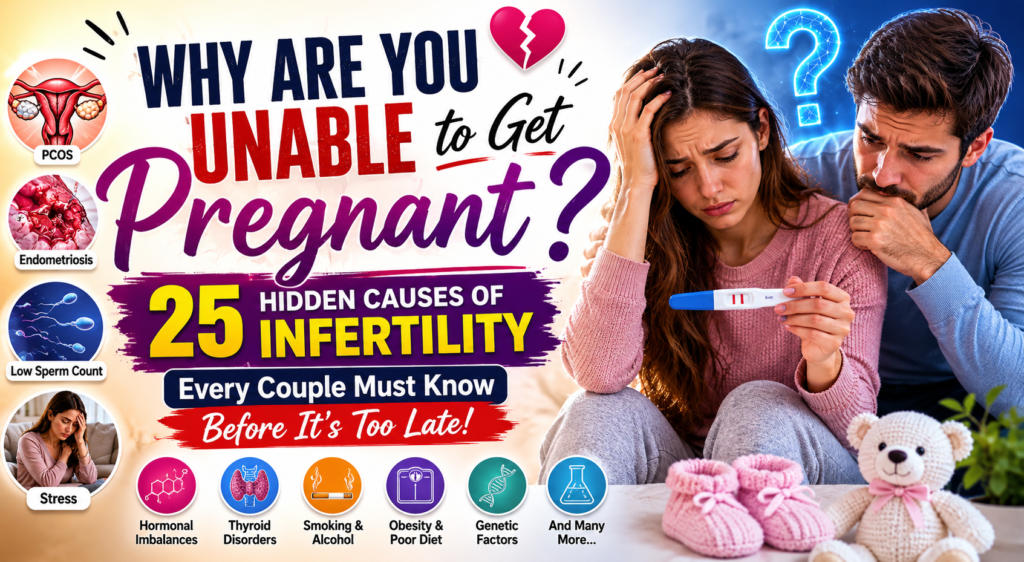
Here are the 25 often-overlooked causes:
- PCOS
- Endometriosis
- Blocked fallopian tubes
- Premature ovarian insufficiency
- Uterine fibroids
- Uterine polyps
- Thyroid disorders
- Hyperprolactinemia
- Pelvic inflammatory disease
- Autoimmune disorders
- Chronic inflammation
- Genetic abnormalities
- Low sperm count
- Poor sperm motility
- Abnormal sperm morphology
- Varicocele
- Hormonal imbalance in men
- Obesity
- Being underweight
- Smoking
- Excessive alcohol intake
- Chronic stress
- Environmental toxins
- Advanced maternal age
- Unexplained infertility
Which Causes Are Reversible?
Many infertility causes can be improved or completely treated through lifestyle changes, medication, surgery, or assisted reproductive technologies. Conditions such as hormonal imbalances, thyroid disorders, varicocele, obesity, and certain ovulation disorders often respond well to treatment. Early diagnosis remains the key factor in achieving success.
Diagnosis and Fertility Testing
When couples struggle to conceive, comprehensive testing helps uncover hidden problems. Women may undergo hormone testing, pelvic ultrasounds, ovulation tracking, and imaging studies to assess fallopian tube function. Men typically receive semen analysis, hormone evaluation, and physical examination.
Doctors increasingly emphasize evaluating both partners simultaneously rather than focusing solely on the female partner. This approach saves valuable time and improves diagnostic accuracy.
Treatment Options and Hope for Couples
Infertility is not the end of the road. Advances in reproductive medicine continue to improve outcomes for couples worldwide. Treatments range from lifestyle modifications and fertility medications to surgical procedures and assisted reproductive technologies such as IVF and ICSI.
Many couples who once believed parenthood was impossible eventually welcome healthy children after receiving appropriate care. Fertility treatment is not simply about technology—it is about identifying root causes, restoring reproductive health where possible, and creating personalized solutions for each couple.
The emotional burden of infertility can feel overwhelming. Yet knowledge is empowering. Every test completed, every diagnosis uncovered, and every treatment explored brings couples one step closer to understanding their fertility journey.
Conclusion
Infertility is far more complex than most people realize. Hidden conditions such as PCOS, endometriosis, blocked fallopian tubes, varicocele, hormonal imbalances, autoimmune disorders, and lifestyle factors can quietly prevent pregnancy for months or even years. The encouraging reality is that many of these causes are treatable once properly identified.
If you and your partner have been trying to conceive without success, do not ignore the signs or assume time alone will solve the problem. Early evaluation, accurate diagnosis, and timely treatment can dramatically improve the chances of pregnancy. Parenthood may seem distant today, but understanding the hidden causes of infertility could be the first step toward making that dream a reality.
FAQs
1. How long should couples try before seeking fertility help?
Most couples should seek evaluation after 12 months of regular unprotected intercourse. Women over 35 should consider testing after six months.
2. Can stress alone cause infertility?
Stress may not directly cause infertility, but chronic stress can interfere with reproductive hormones and reduce fertility potential.
3. Is infertility always caused by women?
No. Male factors contribute to approximately 40–50% of infertility cases, making evaluation of both partners essential.
4. Can infertility be cured naturally?
Some fertility issues improve with lifestyle changes such as weight management, healthy nutrition, quitting smoking, and reducing stress. Other causes require medical treatment.
5. What is unexplained infertility?
Unexplained infertility occurs when standard fertility tests fail to identify a clear cause despite ongoing difficulty conceiving.