
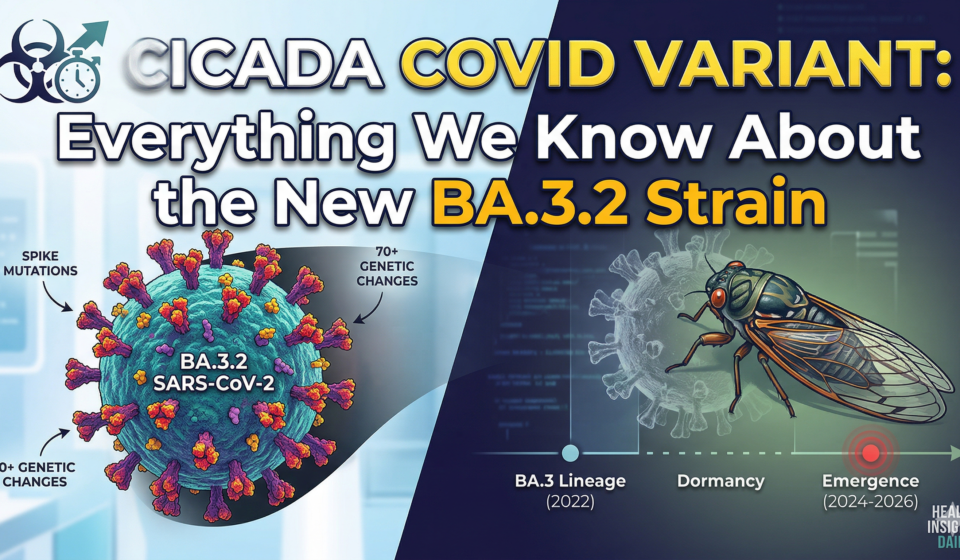

As we move through the spring of 2026, a new name is buzzing in the headlines of public health: the cicada covid variant. Officially known as BA.3.2, this highly mutated strain of SARS-CoV-2 has health officials on high alert across the globe.
While the world has grown accustomed to the ebb and flow of COVID-19 lineages, Cicada is different. It represents a significant genetic leap that hasn’t been seen since the emergence of the original Omicron. In this comprehensive guide, we break down the origins, symptoms, and the latest medical data surrounding BA.3.2.
What is the Cicada Covid Variant?
The nickname “Cicada” was coined by evolutionary biologists because of the variant’s unusual history. Much like the periodic insect that remains underground for years before suddenly emerging, the BA.3.2 lineage is a descendant of the original Omicron BA.3 branch that largely disappeared in mid-2022.
For nearly two years, this lineage was “dormant” in the global surveillance record. Experts believe it likely underwent “cryptic evolution”—mutating quietly, perhaps within a single chronically infected individual—before resurfacing in South Africa in late 2024. By early 2026, it had spread to over 23 countries and is now detected in more than half of the United States.
Why Scientists Are Concerned: The Mutation Count
The most striking feature of the Cicada variant is its genetic divergence. While most recent variants like JN.1 and LP.8.1 (the strains targeted by the 2025–2026 vaccines) were incremental evolutions, Cicada features roughly 70 to 75 mutations in its spike protein alone.
-
Immune Escape: This massive genetic distance means the virus “looks” different to our immune systems. Laboratory data indicates that antibodies from previous infections or older vaccine formulas have a harder time “grabbing” onto this new spike protein.
-
Transmissibility: Despite its mutations, early data suggests Cicada may actually have a lower replication rate than some previous “super-spreaders.” This is why, while present in many states, it has not yet completely overtaken other circulating strains.
Symptoms of the Cicada Variant
For most people, the symptoms of BA.3.2 remain consistent with the Omicron family—primarily affecting the upper respiratory tract. However, there are a few notable shifts in reported cases in 2026:
| Symptom | Prevalence in Cicada (BA.3.2) | Comparison to Past Strains |
| Severe Sore Throat | Very Common | Higher than average |
| Gastrointestinal Issues | Common | Increased nausea/diarrhea reports |
| Night Sweats | Frequent | New “hallmark” symptom |
| Fever/Chills | Common | Standard |
| Loss of Taste/Smell | Rare | Much less common than 2020-2021 |
Note: Some rare reports of skin rashes and fainting have been associated with this strain, though these are not yet considered primary diagnostic symptoms.
Do the Current Vaccines Work?
The 2025–2026 vaccine formula (including Spikevax and Comirnaty) was designed around the LP.8.1 strain. Because Cicada is genetically distinct from that lineage, there is concern about reduced effectiveness in preventing infection.
However, the CDC and WHO maintain that vaccination remains the most effective way to prevent severe disease and hospitalization. Your body’s T-cells—the “memory” cells of the immune system—are better at recognizing various parts of the virus, even if the surface antibodies are slightly bypassed by the new mutations.
Essential Health Tips for the Cicada Wave
To protect yourself and your community from the BA.3.2 strain, focus on these updated wellness and prevention strategies:
1. Prioritize “Hybrid” Protection
If it has been more than six months since your last booster or infection, your antibody levels are likely low. Staying up to date with the 2025-2026 formula provides “hybrid immunity,” which data shows is the most robust defense against highly mutated variants.
2. Support Your Gut Health
Because Cicada is showing an increase in gastrointestinal symptoms, maintaining a healthy microbiome is key.
-
Incorporate probiotic-rich foods like yogurt or kefir.
-
Stay hydrated with electrolytes if you experience any digestive upset.
3. Optimize Indoor Air Quality
The virus still spreads primarily through respiratory droplets. If you are hosting gatherings, use HEPA air purifiers or simply open windows to ensure high air exchange rates, which significantly dilutes viral particles.
4. Targeted Supplementation
While not a cure, maintaining adequate levels of Vitamin D3 and Zinc has been consistently shown to support the immune system’s ability to fight off respiratory infections more efficiently.
5. Practice “Smart Masking”
In high-risk settings like crowded public transit or healthcare facilities, a well-fitting N95 or KN95 remains the gold standard. The Cicada variant is small and airborne; cloth masks offer very little protection against these highly evolved strains.
Cicada (BA.3.2) Variant: Top 10 FAQs
1. Why is the new COVID variant called “Cicada”?
The nickname was given by scientists because the lineage (BA.3.2) remained “underground” or undetected in genomic surveillance for nearly two years. Like the cicada insect that emerges after a long dormancy, this variant resurfaced in late 2024 with a massive number of new mutations.
2. What are the main symptoms of the Cicada variant?
While similar to previous Omicron strains, the most commonly reported symptoms in 2026 include:
-
Severe sore throat (often described as “shards of glass”).
-
Night sweats and extreme fatigue.
-
Gastrointestinal issues like nausea and diarrhea.
-
Standard symptoms: dry cough, fever, and congestion.
3. How many mutations does the Cicada variant have?
It is one of the most heavily mutated strains to date, featuring 70 to 75 mutations in its spike protein compared to the original Wuhan strain. This is significantly higher than the previous dominant JN.1 and LP.8.1 variants.
4. Is the Cicada variant more dangerous or severe?
Currently, there is no evidence that BA.3.2 causes more severe disease or higher rates of hospitalization than previous variants. While it spreads easily, the clinical outcomes for most patients remain mild to moderate.
5. Does the 2025–2026 COVID vaccine protect against Cicada?
The current vaccine formula (targeting LP.8.1) is less effective at preventing infection from Cicada due to its high “immune escape.” However, health experts emphasize that it still provides strong protection against severe illness, hospitalization, and death.
6. Where is the Cicada variant spreading?
As of late March 2026, it has been detected in over 25 U.S. states and 23 countries. It has shown the most significant growth in Northern Europe (Denmark, Germany, and the Netherlands) and parts of Australia.
7. Can I get the Cicada variant if I already had COVID recently?
Yes. Because of its unique spike protein structure, the antibodies your body produced from a previous infection (especially from the JN.1 or XFG lineages) may not fully recognize or neutralize the Cicada variant, making reinfection more likely.
8. How is the Cicada variant detected?
Standard PCR and rapid antigen tests (home tests) are still capable of detecting the Cicada variant. Public health officials also track its spread through wastewater surveillance, which often picks up the virus weeks before it shows up in hospital clinics.
9. Are there unique “health benefits” to catching this variant?
No. There are no medical benefits to contracting COVID-19. While a mild case can provide some temporary natural immunity, the risks of Long COVID and inflammation far outweigh any perceived benefit. Prevention through wellness and vaccination is always the safer route.
10. What is the best way to prevent the Cicada variant?
The most effective strategies include:
-
Staying up to date with the latest boosters.
-
Using N95/KN95 masks in high-risk indoor areas.
-
Improving indoor ventilation and using HEPA air purifiers.
-
Maintaining a strong immune system through proper sleep, hydration, and Vitamin D.