
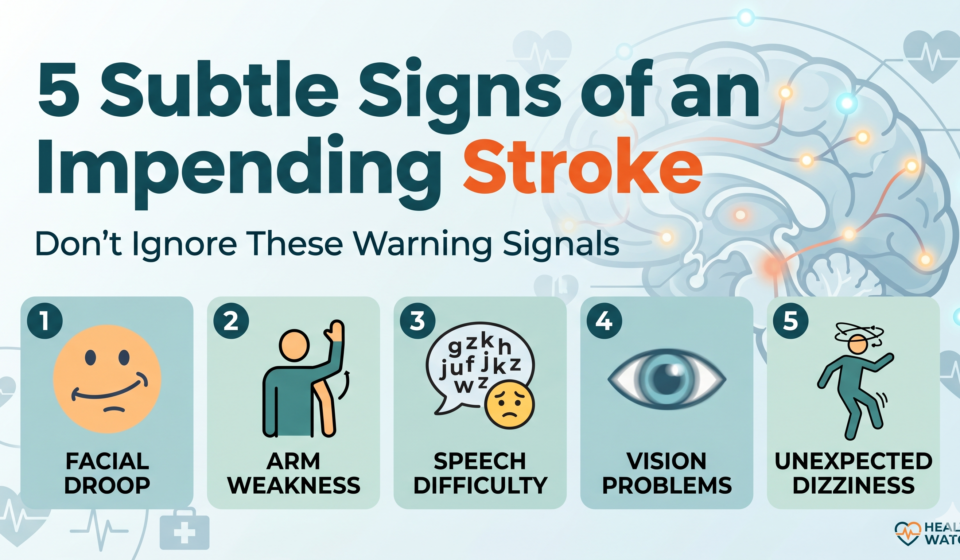

5 Subtle Signs of an Impending Stroke You Should Never Ignore
When we think of a stroke, we often picture dramatic, sudden collapses. But as a doctor, I want to share a crucial truth with you: the brain often sends out quiet, subtle SOS signals before a major ischemic event occurs.
These warning signs—sometimes called a Transient Ischemic Attack (TIA) or a “mini-stroke”—can appear days or even hours before a full-blown stroke. Ignoring them because they “go away” is one of the most dangerous mistakes you can make. When it comes to protecting your brain, time lost is brain lost.
Here are 5 subtle signs of an impending stroke you should never ignore, and exactly how to recognize them.
1. Sudden, One-Sided Clumsiness or Weakness
You go to reach for your morning coffee, and your hand completely misses the mug. Or perhaps you suddenly trip over your own feet on a perfectly flat surface.
While we all have clumsy moments, a sudden loss of coordination, weakness, or numbness—specifically on just one side of your body—is a massive red flag for a stroke.
Why it happens: The brain’s hemispheres control opposite sides of the body. If a small blood clot temporarily disrupts blood flow to the right side of your brain, your left arm or leg will instantly lose its strength or coordination.
2. Transient “Thunderclap” Headaches
Everyone gets headaches, but a stroke-related headache is different. It is often described as a “thunderclap”—a severe, blinding pain that peaks within seconds out of nowhere.
If you experience a sudden, excruciating headache with no known cause, especially if it’s accompanied by neck stiffness or nausea, it requires immediate medical evaluation. It could be a sign of a hemorrhagic stroke (bleeding in the brain) or a warning leak from an aneurysm.
3. Temporary Vision Blurring or “The Curtain” Effect
Imagine suddenly losing vision in one eye, as if a dark curtain is being pulled down over your field of vision. This is a condition called amaurosis fugax.
It might only last for a few minutes before your vision returns to normal, but it is a classic warning sign of an impending stroke. It usually happens because a tiny piece of plaque or a blood clot has briefly blocked the retinal artery in your eye, hinting that a larger blockage in the brain could be next.
4. Mild Slurring or Difficulty Finding Words
You know exactly what you want to say, but the words come out jumbled, or you find yourself substituting the wrong words entirely (like saying “chair” when you mean “car”). Alternatively, you might find it unusually difficult to understand what someone else is saying.
Even if this confusion or slurring lasts for just 30 seconds and clears up, it indicates a temporary lack of oxygen to the brain’s language centers (Broca’s or Wernicke’s areas).
5. Unexplained Dizziness or Loss of Balance
If the room suddenly starts spinning (vertigo), or you feel a wave of unexplained dizziness that makes it hard to stand straight, don’t just brush it off as dehydration or low blood sugar.
Dizziness paired with nausea, hiccups, or difficulty swallowing can mean a stroke is threatening the brainstem or cerebellum—the areas of your brain that control balance, coordination, and vital life functions.
How to Easily Recognize a Stroke: The B.E. F.A.S.T. Method
If you suspect you or someone else is experiencing these subtle signs or an actual stroke, you don’t need a medical degree to diagnose it. Just remember the acronym B.E. F.A.S.T.
-
B – Balance: Is there a sudden loss of balance or coordination?
-
E – Eyes: Is there sudden blurred, double, or lost vision?
-
F – Face: Ask the person to smile. Does one side of the face droop?
-
A – Arms: Ask them to raise both arms. Does one arm drift downward?
-
S – Speech: Ask them to repeat a simple phrase. Is their speech slurred or strange?
-
T – Time: If you observe any of these signs—even if they go away—call emergency services immediately.
The Takeaway: Never Wait and See
The most dangerous thing you can do with pre-stroke symptoms is to go to sleep hoping they will feel better in the morning. If it is a TIA, the symptoms will go away, but your risk of having a major, debilitating stroke in the next 48 hours skyrockets.
Frequently Asked Questions (FAQs)
1. What is the difference between a mini-stroke (TIA) and a full stroke?
A Transient Ischemic Attack (TIA), often called a mini-stroke, occurs when blood flow to a part of the brain is temporarily blocked by a clot. The symptoms are identical to a full stroke but typically last only a few minutes to a few hours and resolve completely without causing permanent brain damage. A full stroke, however, involves a prolonged or permanent blockage or bleed, leading to lasting brain damage. Think of a TIA as a final, urgent warning shot.
2. How long before a stroke do warning signs appear?
Warning signs can appear anywhere from hours to days, or even up to a week, before a major stroke. Research shows that many people who experience a TIA go on to have a full stroke within 48 hours. This is why treating subtle symptoms as an immediate emergency is so critical.
3. Can a stroke happen with no warning signs at all?
Yes, it can. While many people experience subtle warning signs or a TIA ahead of time, a stroke can also strike suddenly and out of nowhere. This is why managing your overall risk factors—like high blood pressure, high cholesterol, and diabetes—is just as important as knowing the warning symptoms.
4. If my symptoms completely go away, do I still need to go to the hospital?
Absolutely. If you experience any of the B.E. F.A.S.T. symptoms and they disappear after 10 minutes, you still need to seek immediate emergency medical care. The disappearance of symptoms usually means a clot has temporarily dissolved or moved, but the underlying issue causing the clot is still there and a much larger, permanent stroke could be imminent.
5. What should I do while waiting for the ambulance if I suspect a stroke?
First, call emergency services immediately. While waiting, keep the person calm, comfortable, and lying down. Note the exact time the very first symptom started, as this is vital information for the paramedics and doctors.
⚠️ Important: Do not give the person any food, water, or medication—including aspirin. If the stroke is hemorrhagic (caused by bleeding in the brain rather than a clot), taking aspirin can make the bleeding significantly worse.