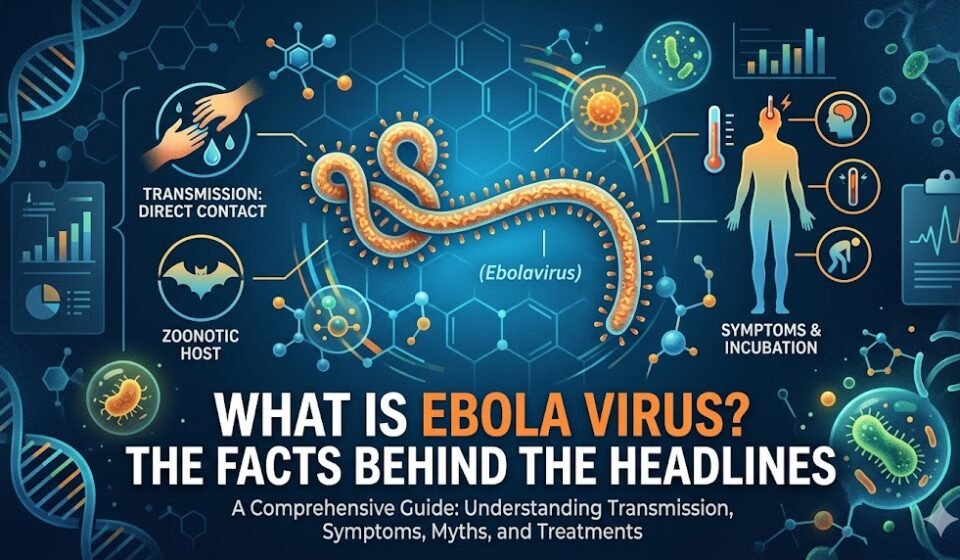

What is Ebola Virus? The Facts Behind the Headlines
Few words in the modern medical lexicon spark as much immediate anxiety as Ebola. When an outbreak hits the news, the headlines are often dominated by fear, graphic descriptions, and worst-case scenarios.
But what is the actual science behind the virus? How does it spread, what does it do to the body, and how close are we to defeating it?
Let’s strip away the sensationalism and look at the hard facts.
What Exactly is the Ebola Virus?
The Ebola virus belongs to a family of viruses called Filoviridae. It was first discovered in 1976 near the Ebola River in what is now the Democratic Republic of the Congo.
It is a zoonotic virus, meaning it originates in animals and spills over into humans. Scientists believe that fruit bats are the natural hosts of the virus. When humans handle or eat infected wildlife (like bats, monkeys, or forest antelopes), the virus can jump species.
How Does It Spread? (Dispelling the Myths)
One of the biggest misconceptions about Ebola is how easily it spreads. Ebola is not airborne. You cannot catch it by breathing the same air as an infected person, nor can you catch it from a casual conversation or by passing someone in the street.
Instead, Ebola spreads through direct contact with:
-
Body fluids: Blood, saliva, sweat, vomit, feces, and semen of a person who is sick with or has died from Ebola.
-
Contaminated objects: Needles, medical equipment, or clothing/bedding soiled with these fluids.
-
Infected animals: Hunting, butchering, or consuming infected “bushmeat.”
Crucial Fact: A person with Ebola is not contagious until they start showing symptoms. The virus cannot be transmitted during the incubation period.
Symptoms: What Does Ebola Do to the Body?
Once a person is infected, the virus undergoes an incubation period lasting anywhere from 2 to 21 days (though 8 to 10 days is most common).
Ebola attacks the immune system and damages blood vessels. The illness typically progresses in two phases:
Phase 1: The “Dry” Phase (Flu-Like Symptoms)
-
Sudden, high fever
-
Severe headache
-
Muscle and joint pain
-
Extreme weakness and fatigue
Phase 2: The “Wet” Phase (Advanced Symptoms)
As the virus multiplies, it causes severe gastrointestinal issues and systemic failure:
-
Vomiting and severe diarrhea
-
Unexplained bruising or bleeding (both internally and externally, such as from the gums or in the stool)
-
Impaired kidney and liver function
The average fatality rate for Ebola is around 50%, though past outbreaks have seen mortality rates ranging from 25% to as high as 90%, depending on the strain and the speed of medical intervention.
The Turning Point: Vaccines and Treatments
For decades, an Ebola diagnosis felt like a death sentence because treatment was purely supportive (IV fluids, oxygen, and managing blood pressure). Today, the medical landscape has completely changed. We now have powerful tools to fight back:
-
Vaccines: Highly effective vaccines, such as Ervebo, are now used in “ring vaccination” strategies to create a buffer of immune people around an outbreak, halting the virus in its tracks.
-
Monoclonal Antibodies: Advanced treatments like Inmazeb and Ebanga utilize lab-engineered antibodies to target and neutralize the virus. When administered early, these treatments drastically increase survival rates.
The Big Picture: Why We Shouldn’t Panic
While Ebola is undeniably severe, the likelihood of a massive, uncontrollable global pandemic is incredibly low. Because the virus requires direct contact with bodily fluids to spread, and because patients become visibly, severely ill when they are contagious, standard public health measures—like contact tracing, isolation, and proper PPE—are highly effective at containing it.
The headlines may sell fear, but the reality is one of incredible scientific progress. Ebola is no longer an unstoppable mystery; it is a manageable disease that modern medicine is actively learning to defeat.
Top 10 Frequently Asked Questions About the Ebola Virus
Here are the top 10 most common questions people ask about the Ebola virus, answered with the latest medical and scientific facts.
1. What is Ebola?
Ebola is a rare, severe, and often fatal disease caused by infection with a group of viruses known as orthoebolaviruses (formerly just ebolavirus). It causes severe fever, systemic inflammation, and can lead to internal and external bleeding. It was first discovered in 1976 near the Ebola River in the Democratic Republic of the Congo.
2. Can Ebola spread through the air?
No. Ebola is not airborne. It is a respiratory myth that you can catch it by breathing the same air, coughing, or sneezing. It cannot be transmitted like the flu, COVID-19, or measles.
3. How do you catch Ebola?
Ebola spreads only through direct contact with:
-
The blood or body fluids (saliva, sweat, vomit, feces, urine, semen) of a person who is actively sick with or has died from Ebola.
-
Objects like needles, clothing, or bedding contaminated with these fluids.
-
Infected wildlife, particularly fruit bats or non-human primates (monkeys and apes).
4. Can someone spread Ebola if they don’t have symptoms?
No. A person infected with Ebola is not contagious during the incubation period. They can only transmit the virus to others after they begin showing visible symptoms, such as a sudden high fever.
5. What are the early vs. advanced symptoms?
Medical experts break Ebola symptoms down into two phases:
-
The “Dry” Phase (Early): Sudden fever, intense weakness, severe headache, muscle and joint pain, and a sore throat.
-
The “Wet” Phase (Advanced): Vomiting, severe diarrhea, stomach pain, impaired kidney/liver function, and in some cases, unexplained internal and external bleeding.
6. How long does it take to get sick after being exposed?
The incubation period (the time from infection to the appearance of symptoms) ranges from 2 to 21 days. However, most people begin to show symptoms within 8 to 10 days after exposure.
7. What is the survival rate for Ebola?
The average fatality rate is around 50%. However, mortality rates have varied wildly in past outbreaks—from 25% to 90%—depending on the specific strain of the virus and how quickly the patients received medical intervention.
8. Is there a cure or treatment for Ebola?
Yes, modern medicine has made massive breakthroughs. There are now FDA-approved monoclonal antibody treatments (such as Inmazeb and Ebanga) that target specific strains of the virus. When these are combined with early intensive supportive care (IV fluids, oxygen, and blood pressure management), survival rates increase drastically.
9. Is there a vaccine to prevent Ebola?
Yes. There are approved, highly effective vaccines (like Ervebo) used to control outbreaks. Public health officials use a strategy called “ring vaccination,” vaccinating the immediate circle of people around an infected patient to create a protective barrier and halt the spread.
10. Can a person who recovered from Ebola still spread it?
Generally, once a person fully recovers, they are no longer contagious. However, the virus can persist for several months in certain areas of the body that are shielded from the immune system, particularly in semen. Because of this, survivors are advised to practice safe sex (using condoms) until laboratory testing confirms the virus is completely cleared.